Reading the Carnegie: ‘The House with Chicken Legs’, by Sophie Anderson

Step inside the house of the title; don’t be alarmed by the fence of human bones, and don’t stop to wonder if this house was even standing here yesterday. Yes, those are great big chicken legs curled up underneath it, and perhaps the house is flexing on them somewhat, poised to move or even defend itself if you prove other than what you seem. A fire is burning, food is cooking on the stove, and a cup of kvass is waiting for you. A mysterious door in the corner of the room remains temptingly shut, but that is for after you have feasted, told your host about your life, and heard a little of hers.

Her name is Baba Yaga. Perhaps you know it already: perhaps you rode with a brave young Prince, in another story, begging for a magic talisman from Yaga to help you track down the fabulous Firebird and win the hand of a princess; or perhaps you arrived by accident at this strange house and helped her daughter to escape, and then were hunted by the witch in her flying mortar, shuddering at every gnash of her great iron teeth. There are many stories told about Baba Yaga, within and beyond the canon of Russian fairy tale.

Jan Pienkowski’s House on Chicken Legs

I have a vague memory of encountering her as a small child, in a picture book of the Firebird? I expect I was inclined towards her because I called Mum’s Mum ‘Baba’ – she disdained ‘Grandma’ because it made her feel old (none of us knew we were using the same name from another culture) – but I found her frightening too. I loved witch-stories from an early age, and I must have responded to Baba Yaga’s unpredictable character: no Glinda the Good Witch, her. She’d help you or devour you on your individual merit. Plenty of ink has been spilled on trying to interpret Yaga’s origins: did she embody a storm cloud, a matriarchal goddess, a lunar goddess, a memory of Persephone?

Whatever her origins, she continues to have a long and varied life. Sophie Anderson’s interpretation – the grandmotherly old woman dishing up steaming shchi from a huge black pot – is faithful both to Yaga’s associations with the dead and her long history of reinventions. This Yaga is a psychopomp (I’ve always loved that word, and get to use it so rarely), guiding the spirits of the dead into the next world. Her house has legs because it covers so much ground, visiting remote corners, where the smell of festive cooking draws ghosts from far and near. Perhaps you hadn’t realised that, seated at this nice table, enjoying the earthly things of the world: you’re being readied for whatever lies behind that door.

Gennady Spirin Baba Yaga

But perhaps you’ve spotted someone else in the house on chicken legs, a girl watching you from the periphery of the scene. Marinka, Baba Yaga’s granddaughter, with a sombre expression. She has never known her parents, only this house and Yaga, and she really should be involving herself more in this process, listening to the specific words, learning the language of the dead, because one day – perhaps sooner than she expects – Marinka will be taking on this role.

But that is there is a problem, one that drives this wonderful novel, pushing its characters to do daring, huge, tiny, impossible, stupid, wonderful, treacherous, human and magical things: Marinka doesn’t want to live this life. She wants to live among people and have friends who are not just spirits on the brink of something else. One day, her Baba will go through the gateway into the land of the dead herself, and Marinka will fully inherit the identity, the history and the responsibility of the Yaga. But if Marinka has her way, she won’t.

Without risking spoilers, it’s worth saying how refreshing it is to see a children’s fantasy novel without a villain. Certain genres and conventions seem unavoidable after a while, and the assumption is often that younger readers demand constant peril and clean moral distinctions. This novel is about a girl whose compass is spinning from the very first page, and we are with her, wishing for some form of escape. We long for her to find a friend or have an adventure that will in some way resolve her anxiety about the future – but every action has a consequence, and this isn’t a story about tidy options. It’s driven by emotion, fuelled by secrets, and its route is unpredictable and bumpy.

The narrative flies along, and Anderson keeps us guessing, but this is also a novel of subtlety, of a sort only a fantasy novel can achieve. When Marinka’s house brings her to a new city, for example, and Marinka throws away her headscarf because it makes her look like a Yaga, or when Marinka agrees to a ritual of formal inheritance while a secret betrayal burns darkly in her heart, complex ideas of cultural difference are being invoked. What might initially appear an adventure about escaeing from a hard life, perhaps with some spooky, Tim Burtonish furnishings, quickly becomes a novel about precisely those details and their authenticity: about how folk and fairy tales like those of Baba Yaga help us grapple with the impossible aspects of the world. It is also about how these tales are an inheritance available to all of us: the House is waiting for you or I to enter, sit down and share our stories.

Ernest Small’s House

Though it carries its character into extraordinary circumstances, their emotional truth is richer for that kernel of folkloric strangeness. Anderson gives the folk tale a cultural authenticity, never simply adopting it for an exotic flavour, whilst also playing about with it making it structurally, even societally meaningful (a whole Yaga culture, with its own rules, stories and newsletters) within Marinka’s world. It’s a deft achievement.

I first read this when it was Book of the Month at Waterstones (in fact, it was launched in our store –three men in red silk shirts playing balalaikas in the history department: it was great). After that it was on the shortlist of the Waterstones Children’s Book Prize, and now it has joined the Carnegie Shortlist (alongside, peculiarly, a number of other children’s novels about grief and death). It deserves all this and a long life too. Not only that, I can’t wait to read what Sophie Anderson writes next.

Reading the Carnegie: Rebound, by Kwame Alexander

Have you played H.O.R.S.E.? All you need is a basketball and a hoop, and at least one opponent. Let them take a shot from anywhere they like, any style, eyes closed, whatever. Now it’s your turn: if they missed, you can take up your own position or style, but if they made a basket, you have to copy their shot exactly. Each person who fails a shot challenge takes a letter: first ‘H’, then ‘O’. Okay, so I’ve never played it in my life – in fact, I had to look it up online to find out what it was, but even I can tell this is the sort of relaxed thing you play when there’s not enough of you around for a proper game, a game of showing off and playing up, a childlike game, low stakes and at the same time a game where individuals are repeatedly put in a spotlight, watching one another and laughing, applauding or swearing as appropriate.

Charlie Bell, the boy at the heart of Kwame Alexander’s Rebound, used to play H.O.R.S.E. with his Dad. Sometimes they played two-on-two against another boy and his Dad; in the summer holidays, they’d take a road trip to another state capital, collecting cheesy tourist attractions and looking forward to rites of passage like sharing their first beer. But two months ago, Joshua Bell had a heart attack and the ambulance didn’t arrive in time.

Now, with the summer of 1988 coming on, and in spite of every inducement thrown at him by his best friend Skinny, Charlie has lost all interest in basketball. He’s lost interest in much of life: he rereads adventures of The Fantastic Four that he knows backwards. He’s morose, angry, lost in cold, dark space. He talks back to his Mom, leaves the dinner she cooked him in the oven, skips school to play arcade games. He fantasises about being a cross between a superhero and a superstar baller, depicted in comic-style illustrations from Dawud Anyabwile (and I wish we had more of them).

If Charlie’s Dad, as he describes him, is a star whose death has created a black hole, it’s that steady suck of gravity we can feel in the first half of the book. Sooner or later trouble, in the form of Skinny’s brother Ivan, is going to prove impossible to resist.

Alexander’s novel is another on the 2019 Carnegie Award shortlist told entirely in verse. But his use of the form feels entirely different to Elizabeth Acevedo and Jason Reynolds: his use of metaphor and imagery is utterly restrained compared to the form, and there is little of Reynolds’ use of ambiguity. Instead, Alexander’s poetry works to place the reader immediately into the action, like a camera picking out specific details to speed the action along. Conversations resound in the head, no background detail necessary. When Charlie can’t answer his mother, which grows increasingly often – or when, now and then, it’s she who cannot find the words – Alexander need only show us the absence, the awkward silence, the ‘…’

Be grateful for what you have, Charlie. Some kids don’t

even have shoes to wear.

How were your tests?

Fine.

Can I have some money for lunch?

When Charlie complains about not having the sneakers he needs to play on the basketball court like he used to, his mother tell him We have everything we need. Not everything, says Charlie. And then it’s just

In a world composed almost entirely of voices, these ‘,,,’s are bigger than pauses, they are moments when the world freezes and empties of life. But as the title suggests, this is a novel of optimism and change. It begins with Charlie being sent to spend the summer with his father’s parents in Washington, a household of tough love, hard work and home truths, but also of some surprising emotional connection with Charlie’s Grandaddy. But where the book – and Charlie – come alive, is back on the basketball court, with Charlie’s ultra-dedicated cousin Roxie. You can feel the book’s heartbeat quicken:

 ‘cause she’s like

a magician

and the ball is

her hat

and they all look

at each other

in awe

like she just pulled

a rabbit

out of it

when she fakes

a jumper

then passes

the ball

right between

Red’s legs

to HERSELF

and lays up

an easy point.

It’s all action, no room for ‘…’s. All it takes us a ball passed to him out of the blue, the spotlight on him, taking a shot he didn’t want to, and then, to coin a phrase, running with it.

This is not the novel I expected it to be: far from a dark Young Adult tale, it’s a middlegrade adventure with an off-kilter sense of humour and an ever more empowering, upbeat attitude. I enjoyed the basketball material more than I’d have expected to, even if the storyline becomes a little too predictable, the life lessons a little too homespun.

But then, this is an unashamedly aspirational tale. It’s a tale of heroes – Josh Bell was as ‘knucklehead’ kid according to his father, but grew up to be a ‘a star / in our neighbourhood’, running adult learning classes and night school for troubled kids – who don’t necessarily ride have a ‘time sled’ with which to correct the past. Because

being this close

to victory

makes me hate

defeat.

I want to be

the hero

in my story.

The Longest Night of Charlie Noon, by Christopher Edge

One question I’m always asking about middle-grade fiction is, where’s the science-fiction: the wild and wide-eyed adventures, and the big ideas about science or sentience or society? That might be starting to change, with Kirsty Applebaum’s gripping dystopia The Middler and Frank Cottrell-Boyce’s moving and funny Runaway Robot both published this year with great reviews.

Christopher Edge, however, has been flying the flag for children’s sci-fi since 2016’s The Many Worlds of Albie Bright: not just redeploying the tropes, but using them to tell philosophically, emotionally rich tales that are distinctly his. The Many Worlds that Albie explores, parallel to our own, are not just explorations of quantum theory – utilising CERN technology and an old banana, in true Doctor Who/First Men in the Moon style – but also a quest for a lost parent that takes us into big questions about character, history and grief. The Jamie Drake Equation is about the heroism of astronauts, the fallibility of parents, messages from distant stars and the Grand Unified Theory that draws them all into one meaningful pattern. The first Edge novel I read, The Infinite Lives of Maisie Day, takes readers to the edge of existence beyond. It excites the reader, provokes questions and springs surprises, but it also moves us and, like Edge’s other novels, leaves us on a note of hope.

Holloway image by Stanley Donwood

The Longest Night of Charlie Noon, published this week, is another novel of surprises: nothing is quite what it seems. When Dizzy takes his friend Charlie to the woods, it’s to find who has left secret messages on the path, mysterious signs made out of bent twigs. Is it a spy? Is it a monster? Is there really a wild man hiding out there? Or could it all be a trick laid by Johnny, the toughest kid in school?

Before these questions have been satisfactorily answered, the three realise they are lost. However far they walk, they never seem to reach the edge of the woods. Night falls unexpectedly quickly, and when Charlie climbs an oak tree to look for the North Star, the night sky looks completely wrong. And meanwhile, it seems the children really are being followed.

It’s clear from the opening of the novel that this is a story about time: ‘Can I tell you a secret? Once upon a time doesn’t exist. This story starts once upon a now.’ But what Edge has accomplished here is no straightforwardly sci-fi novel. Though it is clearly illuminated by the science of time – he acknowledges the work of Carlo Rovelli and James Gleick, among several other scientific approaches – what we have here is closer to Maisie Day in exploring the philosophical and phenomenological aspects of his theme. As well as Rovelli, Edge mentions Alan Garner’s collected essays, The Voice that Thunders, and Charlie Noon also reminds me of Garner’s later novels, Red Shift, Thursbitch and even Boneland, except that it’s a great deal more enjoyable and digestible than those. There are echoes of Garner’s contemporary, Penelope Lively, of Astercote and even more of her adult novel Moon Tiger.

Nether, by Stanley Donwood

Garner and Lively are both archaeologically-minded writers, and an archaeological concept appears to inform Charlie Noon in the way that quantum physics did Edge’s earlier novels: deep time, the sense of the world’s ancientness (and vast futurity), in which human beings can appear insignificantly small and agency. It’s a universal theme that nonetheless speaks particularly to children, who are sometimes made to feel just that, pinpricks in the bigger history of their ecology, their culture and their families: look at the framing of their ecological protests in recent months. ‘Viewed from the perspective of a desert or an ocean, human morality seems absurd – crushed to irrelevance,’ writes Robert Macfarlane in Underland, but equally, ‘[at] its best, a deep time awareness might help us see ourselves as part of a web of gift, inheritance and legacy’. It’s a shift in perspective that offers hope when the present moment appears intolerable, as in Charlie’s claustrophobic home life: what seems immovable as rock was once fluid and shifting: ‘There is a way out of the woods.’

Deep time compels us to work our imaginations on scenes and situations that appear unalterable, and show us the life, violence and movement embodied by rock formations and rivers. It makes a wild tempest of the landscape, in which Charlie and the others must become immersed in order to understand themselves and their place in it. Past and future time are part of the storm, too, in ways that seemed particularly alive and pertinent, given this week’s D-Day commemorations. Narrative convention itself is shaken by thunder and struck by lightning: once upon a time doesn’t exist and the future is yours to write. Reading and decoding run through the novel, and for me it chimed with something Michael Rosen said at a Reading for Pleasure conference last month, about reading as not merely an act of comprehension, but interpretation.

The Heart of the Forest, by Denys Watkins-Pitchford (aka ‘BB’)

Comedy, high adventure and stories of personal drama each have an important part to play in children’s reading, but we must also celebrate novels that allow room for interpretation, that leave gaps for readers to bridge, that ask questions without easy answers, that are strange and mysterious and even disconcerting. The Longest Night of Charlie Moon is at times a deeply strange novel, and hooray for that.

From one simple idea, page-turningly linear, told with elegant economy and deceptive simplicity, The Longest Night of Charlie Noon branches out into all manner of subjects, stories and concepts. Like Edge’s earlier novels, it concludes – it feels wrong to say that it ends, after all these non-linear shenanigans – with an emotionally resonant resolution, and on an optimistic note. I don’t think I’m alone in saying that stories of hope are desperately required at this point in history, and not just by the children amongst us.

You might also be interested in my review of The Infinite Lives of Maisie Day on my old blog, where there is also quite a lot about Alan Garner, one of my essential authors.

Reading the Carnegie: Things A Bright Girl Can Do, by Sally Nicholls

“Remember how they used to laugh at us? And say it weren’t worth it, going to prison and that, for a cause? Bet they ain’t saying anything like that to the boys at the Front, is they?”

As Sally Nicholls’ new novel begins, it’s spring 1914 and women do not have the vote. Three teenage girls are about to involve themselves in that fight, and their story is first charming, then exciting, then moving and finally inspiring.

By chance, May encounters Nell in the crowds outside a public meeting at the Bow Baths Hall. The speaker is Sylvia Pankhurst, a campaigner not only for women’s suffrage but the rights of working-class women like Nell, whose large family struggle on the breadline. Nell is an outsider in her own community, swaggering in her brother’s breeches and only interested in boys for the opportunity of a scrap: she’s also not averse to carrying a nightstick to Pankhurst’s talk (though only in defence against anticipated police violence). May, by contrast, is used to a more middle-class, less aggressive form of protest: though she idolises Boudicca, “if I was [her], I wouldn’t go to war, because I’m a Quaker and we’re pacifists … I’d use diplomacy and political wiles instead. Miss Aitchison said it wasn’t ladylike for women to involve themselves in politics.” She and her mother are proud Suffragists, but Pankhurst’ s political message resonates with them: she is thrilled by the fervent atmosphere of the talk and, both personally and politically, by Nell. Having borrowed her mother’s copy of Edward Carpenter’s The Intermediate Sex, she is not for one second ashamed about pursuing her. As much as the story of their political fight, this is almost immediately the story of their rapidly intensifying relationship.

 Equally by chance, May sells a copy of Votes for Women to young Evelyn; of the three she has seemingly the most conservative home scenario: quiet life as a dutiful daughter, respectably paired with her childhood sweetheart, Teddy, and discouraged by them from pursuit of a University degree. Yet, of the three, she will undergo some of the greatest physical hardships of the cause, and her dream of an Oxford education is not to be easily dismissed. Nicholls’ novel follows these three individuals, their families and lovers as they fight, suffer and pursue extraordinary adventures in the four years leading through the darkest of times toward the coming of the Representation of the People Act.

Syrett’s illustration to Sharp’s story ‘Anyone Else’s Prince’

The period is faultlessly evoked. Each detail is deftly painted in, without crowding the mental image like a naff costume drama. Moreover, character dialogue is perfectly captured. In an interview with the In the Reading Corner podcast, Nicholls describes reading novels of the time, including children’s literature like E. Nesbit’s, which we know (like middlebrow fiction) frequently offers us a clearer window onto social mores than literary fiction. As a side-note, I’m startled to learn that Nesbit was not herself involved in the cause of women’s suffrage, whilst Nicholls’ interview for In the Reading Corner has introduced me to the work of Evelyn Sharp, a campaigner in the Pankhurst mould but also a prolific children’s author, whose fairy tales are available on Gutenberg along with their beautiful stylised illustrations by Nellie Syrett, and who provides Nicholls’ book with a brilliant epigraph. Sharp’s fairy tales remind me strongly of her contemporary Frank Baum’s, and wear their radical politics on their sleeve: “The boys in my country are so brave,” says Princess Winsome, “that … [they] stop all the games by fighting about nothing at all; and it’s dreadfully dull when you’re a girl, isn’t it?” It’s a mannered style though, and Nicholls’ characters speak to with a zeal and looseness that is decidedly Nesbittish, not glowing like silver but glinting with steel.

These are women raised with not-so-great expectations for their future (particularly Nell) who nonetheless relish life:

May, to Nell, was like opium. Like brandy on a cold day. Like an electric shock. She made everything blaze. What did all the petty mess of manners matter when there was May there, waiting?

1910 poster by Alfred Pearce

It’s an educational book (with the odd concession to younger readers – or not-very-young readers like me, who need more context) but it’s as much an education in what it felt like to be living through rather-too-interesting-times: caught up in a mob or undergoing a hunger strike, and more particularly once Britain slips into war. I have rarely seen a depiction of the home front so nightmarish, even in Hilary MacKay’s glittering The Skylarks’ War. Perhaps it is the portrayal of Nell and her family, already impoverished, being pushed closer and closer to breaking point: perhaps it is the subtle but obvious parallels to jingoistic attitudes of today. Nicholls’ magic trick in Things A Bright Girl Can Do is to show us an historic event that we feel we know, and make it uncomfortably raw. We all know – and it feels inevitable — that during both World Wars, women took on jobs left vacant by fighting men, but here we consider the sense of loss and desperation that led to this first violent shift in consciousness. We know full well that policy changed somewhere, but we reflect here on changes in mentality:

I feel like my brain is being rewritten [a character writes], all my nerves unravelling and reknotting themselves – it’s disorientating, of course, but it’s perfectly thrilling too. I feel like I’m unfolding, and I’m just wild to see what I’m going to unfold into.

It’s a dangerous choice, following each of the three women by turns with equal attention. Much simpler to take one girl on her journey through the maelstrom, have a few cameos from major figures, and end on a brilliant victory. Yet the novel’s structure makes a page-turner of a complex, lengthy process for which (we think) we already know the outcome. Each young woman’s approach to the cause is subtly different, and each has their heroism in different circumstances. We cheer them on for their radicalism, all the more for the ambivalence and often outright abuse from their peers.

Nicholls’ approach reflects her unwavering fidelity to the complexity of the campaign: not as streamlined or logical as we might like it to be, as messy and complicated and full of difficult choices as real politics (as life itself) continues to be, a century later. What do you believe in, and what do you believe in doing about it: persuasion, activism, sacrifice? It was a powerful experience to read this novel in the same year I read Old Baggage, the witty and moving novel of the Suffragette cause ten years after their (partial) victory 1918; but Things A Bright Girl could equally be read alongside 2017’s The Hate U Give by Angie Thomas, which describes the journey of one girl toward political expression. We are living in an era when Young Adults will be more likely to be marching, painting banners and involving themselves in political struggles (whether like Evelyn, May, Nell or Boudicca). This will make an inspiring read for them.

PS: Note to publishers — more LGBTQ historical YA, please!

Reading the Carnegie: The Poet X, by Elizabeth Acevedo

Reading the Carnegie Shortlist for 2019, it has sometimes seemed – of all the themes you might expect of a children’s literature award – that every book was about death. The Poet X, by Elizabeth Acevedo, is about life. Xiomara is a teenager in Harlem, and this is the story of her coming of age. Her first love, her first sense of ownership and delight in her own body, her first glimpse of the real life going on behind her twin brother’s quiet eyes, and most significantly of all, her first confrontation with her Mami, whose hard-line approach to Christianity makes all of the above dangerous territory for Xiomara. Far from a novel about loss, this takes us through a world increasingly crowded with lives – family members, a potential boyfriend, an inspirational teacher, a watchful pastor, and one close (if somewhat disapproving) ally. Then there are audiences and peers to meet in the brave new world that Xiomara is drawn to explore, despite her fears: the intimidating, energising transformative world of slam poetry. This is a novel pulsing on every page with the lifeblood of its narrator’s voice, and it’s a voice that gathers energy with every fresh episode.

What Twin Be Knowing

As I’m getting ready for sleep, I’m surprised

to see the crumpled poetry club flyer

neatly unfolded and on my bed.

It must have fallen out of my bag.

Without looking up from the computer screen,

Twin says in barely a whisper,

“This world’s been waiting

for your genius a long time.”

My brother is no psychic, no prophet,

But it makes me smile,

This secret hope we share,

that we are both good enough

for each other and maybe the world, too.

But when he goes to brush his teeth,

I tear the flyer into pieces before Mami can find it.

Tuesdays, for the foreseeable future,

belong to church. And any genius I might have

belongs only to me.

Yes, if you’re interested in other themes of the shortlist this year, here’s a stylistic one: Acevedo’s is not just the story of a slam poet in search of her voice, it is told (like Jason Reynolds’ Long Way Down and Kwame Alexander’s Rebound) in free verse. In this choice, it distinguishes itself from (2015 Carnegie shortlistee) Apple and Rain, by (2016 winner) Sarah Crossan, whose young protagonist Apple is also learning to explore her emotional landscape through poetry, but which is predominantly related in prose. As with Crossan’s novel, though, the reader is invited to read over the shoulder of the protagonist, seeing the work they each produce for their English Lit teachers as well as their first (and sometimes second and third) drafts: private, confessional, electrifyingly vital. It’s an instantly immersive, engaging device, not only welcoming us into Apple and Xiomara’s heads but also leading us through the process of articulating (and more to the point, self-censoring) that each girl makes as she negotiates what it means to put her life on the page, for herself and others.

The choice to tell the whole of Xiomara’s story in verse makes a world of difference, though, and the nature of its author (as a young woman finding her way as a writer) produces a different effect again from Reynolds’ Long Way Down. It’s almost impossible for the reader of The Poet X to separate Xiomara’s account of events from the poetic reckoning she makes of them in her private notebook.

When Xiomara’s Mami uncovers the notebook, we know exactly what territory she is trespassing on; she has been reading alongside us. Not only outpourings of religious scepticism, of raw sexuality, of angry rebellion, but poems that capture Mami herself on the page, unfolding her history and articulating it for us: the life of a woman who “barely spoke English / and wasn’t born here, / but … didn’t let that stop her / from defending herself / if she got cut in line at the grocery store / or from fighting to get Twin into a genius school”, whose “hands will be scraped raw from work / but she still folds them to pray”. Mami, we know, grew up in the Dominican Republic planning to dedicate herself to God, was pushed into marriage and emigration by her family and has still not forgiven Papi “for making her cheat on Jesus”; she is suspicious even of Xiomara’s attempts to understand her own body (“Good girls don’t wear tampones”). When we arrive at that stand-off, we see that book of poems afresh, realise how incendiary they are and at the same time, how essential to Xiomara. They are a space of private reckoning and comprehension, not only of joy and pain but the world they grow out of, including her mother’s history. There is an urgency to Xiomara’s private words, mirrored by Acevedo’s own intervention in the predominantly white canon of YA literature.

I first read The Poet X last year because of my role at Waterstones: it was a shortlisted title for the Waterstones Children’s Book Prize. I expected to find it interesting, but was unprepared for how utterly addictive it grew. I read most of it in one sitting, compelled to see how this brilliantly realised heroine – too tall to blend in, too devoted to her family to break away, and too excited by music and poetry to let herself be broken – would make her way through that labyrinth of relationships. (The book’s one flaw for me is that Twin is made real in a few deft strokes, and his story, which poignantly mirror hers, is resolved too quickly and easily – inevitably being secondary to Xiomara’s tale.) Of course, I thought, she would find the strength to perform her work at the slam, but where, and with what compromises? Could she retain both the intimacy and the fighter’s spirit that characterise the novel? Could she protect herself without turning away from this or that relationship? Could she, in every sense, keep it together? In the end, I was reminded me of the themes and approach of my all=time favourite writer, Jeanette Winterson, who made a similar escape to Xiomara and did it through literature too: “I can change the story,” Winterston writes. “I am story.”

I’m thrilled that The Poet X has a place on the Carnegie shortlist: it demonstrates not only how verse can bring a story to life, but also how words can bring us through life: showing what we can be and celebrating who we are.

Reading the Carnegie: A Skinful of Shadows, by Frances Hardinge

If anyone enjoyed my Puffin post a few weeks ago and is hoping for more about older children’s books, do not fear: I’ve been reading plenty of terrific stuff from past times (books by the likes of Jan Mark, Betsy Byars and Maurice Gee) and I look forward to sharing them with you. On the other hand, I had completely miscalculated my own blog schedule for discussing the Carnegie Award (my watch was fast: I told you butter wouldn’t suit the works) and if I talk about a novel a week until mid-June I will only just cover the shortlist before one of the authors lifts the trophy (or puts on the crown or accepts their medal: I really have no idea). So, for the next few weeks, it’s going to be living authors all the way.

That said, there’s more than a little ghostly overtone to the shortlist this year. It’s not unvisited territory for the Carnegie, either: previous winners have confronted the monstrous emotions of grief and mortality, made friends (and family) of the undead, unearthed bodies from prehistory, taken bereaved children on a crime caper, and way back in 1973, made a comedy of a 17th century apothecary’s arrival in an age of washing machines, radios and chemist shops. So far this year, however, the voices of the dead seem inescapable and manifest in vared forms.

From the 1950s to 80s, ghosts were a major presence in children’s literature. Armada published fifteen eponymous anthologies of spooky tales, and there was still appetite enough for Haunting Tales, The House of the Nightmare and Small Shadows Creep (to name just three) from Puffin, as well as collections from Beaver, Magnet and Lions. There were ghosts in novels by John Gordon, Penelope Lively and Joan Aiken, to say nothing of the Green Knowe series. As well as appealing to young readers’ taste for sensation, ghosts seem to offer a literary bridge into themes of history, family and the soul. Not that all ghost stories are about the spirits of the departed, of course – they can just as often be about the world of rationality being broken into by spectres of sheer unreason. They might just be there to show us how mere words on the page can make the body shudder and shake.

Frances Hardinge’s A Skinful of Shadows makes fairly comprehensive use of the undead. When Makepeace is a child (in a Puritan community in 17th century London, if you’re wondering about the name) she first encounters the dead as nightmarish spirits, desperately trying to invade her and hold onto life. Thankfully, her mother seems to know plenty about the matter: the dead are like drowners, she explains, and are to be pitied but also kept strictly at bay. Sharpen a stick, she tells Makepeace, or you may find yourself taken over. London is a place seething with the unquiet living, however, and when Makepeace is barely a young adult, an encounter with mob violence changes her life with brutal suddenness.

Now Makepeace finds herself a kitchen maid – and to all intents and purposes, a prisoner – of the queer house of Grizeways. The noble Felmotte family have some strange secrets and traditions which directly concern Makepeace’s aptitude for the uncanny. As the novel unravels, with all sorts of deceptions and desperate gambits, Hardinge introduces ever more variety in the world of ghosts: the desperate, the inhuman, the half-destroyed, the hardened and the peculiarly verbose. What will they do to Makepeace, and in some instances, what can she do for them?

With this imaginative complexity, therefore, Hardinge makes full use of children’s literature’s peculiar flexibility: to combine a satisfying exploration through all manner of philosophic themes with a thrilling adventure novel. In order to succeed in her quest – in order, in fact, to survive in a universally violent world – Makepeace is obliged to make a full enquiry of herself, her times and the rules of the world beyond them (whether interior or exterior to them both). In what sense, Hardinge asks, can we speak of a memory as ghostly, or a hope, or a stranger, or a façade, or a mentality? Without claiming this as an especially political novel (especially given Makepeace’s estrangement from either side of England’s civil war), the brilliantly mad secret of the Felmottes even resonates with the language of “a dreadful spectre haunting Europe”.

Sometimes it’s a shame, I think, that Makepeace is so disengaged from the politics of the country, much as it makes sense for someone in her circumstances, always living at one remove from society. Her world is painstakingly evoked and the novel is deliciously (and just as often, repulsively) atmospheric: from the not-quite-town of Poplar to the lonely marshes, into every strata of life in the house of Felmotte and thereafter off out desperately across across the fields to lonely cottages, you are in Makepeace’s shoes, breathing the air about her, feeling the nearness of death and the madness of the age. There are also insights to be gained about women in this mad world: authors of their own destiny, in the case of the “she-intelligencers” to the King, or author of the end of the world, in the role of prophetess. Then there are the accusations of witchcraft for trespassers beyond respectability: lives of the powerless rewritten by others, on a charge of illegitimate power. Interestingly, although this novel of possession and infiltration has an aura of sexual violence, Hardinge chooses to keep that firmly as subtext.

Though they evoke different eras, Hardinge’s adventure most reminded me of Joan Aiken’s Wolves chronicles, particularly having read The Cuckoo Tree only a couple of months ago, which moves from secret plotting to desperate venture (with witches!). Like Aiken, Hardinge is unafraid to spiral outward from incident to incident. The last few chapters are particularly frenetic, and perhaps I missed the scene-setting and mystery of the novel’s opening. Perhaps it was not even the change in tone, but the scale of the book – it ends with a bang, but if you’re going to do that, I believe you might as well go the whole hog and shove a packed St Paul’s Cathedral into the river. That said, I delighted in certain set-pieces: each one perfectly founded on the elegant logic of the novel’s cosmogony, no character safe and no loopholes provided. With its smoky, shadowy, strange, owl-ridden, blood-splashed, flashing-grinned, dark-windowed, lantern-gleaming, eye-glinting, candle-flickering visual repertoire, this would make an amazing movie.

It is a thoroughly pleasing, perturbing and thought-provoking novel, though: a novel about author-ship and ventriloquism. “… I am nothing but a bundle of thoughts, feelings and memories, given life by somebody else’s mind,” observes a character, at the end of the novel, “But then again, so is a book.” Hardinge reveals that to be a dark art indeed, but also a wonderful, blazing adventure.

Reading the Carnegie: Long Way Down, by Jason Reynolds

Will’s big brother Shaun is dead. He was shot in the street. The news is seismic; with Will’s Dad long since passed before he could know him, Shawn was his mentor, confidant and role model. One thing Will learnt from Shaun was a simple set of rules: you don’t cry, you don’t snitch, and if someone you love gets killed, you avenge them in kind. As Will says, these rules

weren’t meant to be broken.

They were made for the broken

to follow.

This is a novel in verse. My new job involves the odd conversation with creative writing students, and we were talking recently about the renaissance in poetry reading among young people (I was thinking of writers like Rupi Kaur and Yrsa Daley-Ward whose Instagram fame has converted into book sales). I could tell this one young man was surprised when I told him about the verse novel is a major phenomenon in Young Adult writing. Yes, Robin Robertson’s novel-length poem The Long Take was a Booker shortlistee last year, and Max Porter’s indefinable work Lanny will (I hope) garner further awards this year: by contrast, the likes of Sarah Crossan and Brian Conaghan have long since made it a form to be reckoned with in YA literature. This year’s Carnegie Prize alone features three novels in verse – and I think that’s remarkable.

Chris Priestley’s illustrations understated and powerful

The author makes extraordinary and varied use of the form. One surprising thing is how natural it feels: telling the story in Will’s voice, Jason Reynolds affords himself all the more freedom to capture the human voice; the voice of testimony, loss and adolescent swagger, all the while liable to shift like a riverbed in a stream and show something more beneath the surface.

Elsewhere, it effortlessly depicts the power of grief to disorientate: as we read, words and phrases fracture and the novel opens out into the silence of white space. These are the words of a young man whose world has split down its fault-lines and – as he shoves his brother’s pistol in the waistband at the back of his jeans and boards the elevator on his mission of revenge – a world threatening to fall apart entirely. It’s a world held together by rules, stories and creeds, and Reynolds’ poetry emphasises the strangeness of that linguistic world. His narrator has a thing for anagrams:

same letters,

different words,

somehow still make

sense together,

like brothers.

It’s a device Reynolds uses in his novel Ghost, which I also read this week, in which a boy (younger than William, potentially reflecting their respective readers) accidentally find a talent for running, and returns with fascination repetition to his copy of the Guinness Book of World Records. It nicely frames a child’s view of the world – and like the Ghost’s verve and nuance, it reminded me of Betsy Byars’ writing and her protagonists’ defining traits – and it takes its protagonist subtly into questions of measuring and achieving greatness. It’s an honest depiction of children’s naivety but in a way that stresses their power and potential.

Ghost is a heartwarming, pageturning, wisecracking adventure in one boy’s real life of troubles and joys. A couple of glancing but substantial references to extremely bad fathers raise the ‘maturity bar’ in my opinion (I wouldn’t be so foolish as to put an absolute number on it) but I do hope it continues to grow in reader and bookseller awareness: Reynolds’ narrative fluency and deftness with character make it a dynamic reading experience and give us an authentic, empowered, complex young black hero. And you don’t have to care (as I do not care at all) about sport.

Another Chris Priestley illustration

For what it’s worth, the sensitivity deployed in Long Way Down means I would recommend it to both younger and older teenagers. It will show them some of the things a novel can make us feel. It’s a dark tale, though – you know that within a few pages, but as Will’s elevator makes its first stop and a man gets on, someone Will knows, and that he knows should not be alive to board that elevator, things go darker by a shade. And I do mean shade, in the spooky sense: the first of several to join Will for a conversation.

Here, Reynolds’ use of verse and his capture of Will’s voice take on a new variation, as the story gains the overtones of folk tale, ghost tale, urban legend, cautionary tale. We are unsettled and we are moved, but we are never left with such a definitive viewpoint that Reynolds’ story loses its subtlety. The author-illustrator Chris Priestley reflects Reynolds’ tone, startlingly real and teasingly strange, in his brilliant illustrations. In smoky black white close-ups and cutaways, Priestley draws us deeper into the claustrophobia of Will’s world. We hear him tell his unbelievable tale; we catch glances of his indescribable world; throughout the whole reading experience, it is the reader who has to answer the questions posed by the novel, right up to its final page.

I’m thrilled that Long Way Down is on the Carnegie shortlist. It’s a journey all curious readers should make.

Reading the Carnegie: ‘The Land of Neverendings’, by Kate Saunders

David Dean’s beautiful cover art

It seemed appropriate, returning to the Carnegie Shortlist, to alternate and talk this time about a book for ‘middle-grade’ readers (though, that’s a strange designation, isn’t it? Not quite so good for the self-esteem than ‘young adult’). At first glance, this latest novel from Kate Saunders (of whom I only know the pitch perfect E. Nesbit sequel, Five Children on the Western Front) appears aimed at a distinctly young reader: when Emily learns a door has opened between the world of imagination and the real world – the Hard World – she makes the acquaintance of a multitude of stuffed toys, and helps repel an invasion of sadness incarnate. Indeed, the book does delight in funny rhymes, cuddly characters and food fights, but from the first line, we know we will be exploring a much heavier theme: ‘When Holly died, Bluey suddenly fell silent and all the lights went out in Smockeroon.’

Smockeroon is the land devised and narrated by Emily for her older, critically ill sister Holly, although both girls have inhabited it imaginatively. Bluey, Holly’s beloved teddy bear, lives in Smockeroon and spends his days there indulging in jelly fights and inventing such life necessities as the five-minute Fart Siren alert. Holly is dead from the first page and her family’s sense of loss is felt throughout the novel. Initially, Emily is totally withdrawn (and at the same time, abandoned by old friends), she devotes her attention during class to her Bluey Book, a private chronicle of memories of Smockeroon, and the occasional new invention, now without an audience. On meeting the stuffed penguins and dolls that stumble accidentally into her room, though, she learns something impossibly wonderful and wonderfully impossible: Bluey, though cremated in the real world, lives on in Smockeroon and “spends most of his time playing with his owner”.

I must admit, my hackles rose at that point. Not only had Saunders firmly established by now that the endlessly sensitive subject of grief (and a child’s grief, too) would be central to her story, it now seemed that she would be exploring it with the most mawkishly sentimental tropes imaginable. This is a dangerous line to walk, and throughout the novel I was unsure whether Saunders would guide us satisfactorily through. The novel is wonderfully witty, the kind of wit that effortlessly knits together realist and fantastical worlds with language and character. But Emily keeps looking back longingly towards Smockeroon, even when it seems extraordinarily dangerous to do so, drawn by the unquenchable hope of seeing Holly and Bluey again. Each time I wondered, how will this, how can this be resolved in a way that does justice to its characters, its themes and its readers. I was intrigued to see reader recommendations on the flyleaf from Yzabelle and Priya, age 8, as well as Gina and Darth, age 9. The sunlit primary colours of the Land of Neverendings are muted by authentically dark shadows.

It’s clear from the book’s Afterword, though, that this is a very personal novel. Smockeroon’s alternate name, ‘the Land of Neverendings’, derives from the imaginary world made up years ago by antique shop owner Ruth for her son, Danny, before his death in a road accident. Ruth has a crucial role in the novel as a strong, responsible adult figure, capable of offering guidance and experience of grief (complemented, here and there, by words from Emily’s English teacher, with her own experience of grief). She is never a dry, functional character, however – she is a full-on participant in the adventure, risking nearly everything for the dream of entering Smockeroon and visiting her son there. Occasionally, she is as much in need of emotional guidance as Emily. The result is beautifully balanced, the tone of the novel never becoming twee or distressing. I can imagine this novel being a consoling experience fpr some readers, but not because it avoids jagged, difficult emotional terrain. It explores them, however, with a sure tread and as the novel progresses, makes toward safer ground.

The plot demands that Emily cannot enter Smockeroon and take part in events there, which makes for an unconventional and satisfyingly understated plot. The last third of the novel, though, I found a little less satisfying – a quest in the real world where the stakes never quite feel as high as they seemed when wrapped in mystery. Conscious of the author’s terrific earlier success with Nesbit’s Psammead, the search for ‘an old magic bear’, a bear that ‘[thousands] of children have seen … and loved … and filled him with huge amounts of imagination’, feels tantalisingly like it will lead to re-enchantment of (perhaps) the world’s ultimate teddy bear. Perhaps in a parallel world, Emily and co. avert production on Disney’s 2018 schmaltzfest Christopher Robin, and sit down to re-read The House at Pooh Corner. Perhaps, too, I’m reading as a stuffy adult with a yen for metafiction; the solution to the quest, when it comes, is more original (and many people are with Dorothy Parker in pooh-poohing Pooh, to say the least). In any case, the shift seems to move us away from more difficult emotions, making it an easier recommend to such younger kids as Priya and Darth.

The novel’s conclusion aside, I found it mining rich territory. Once you begin thinking of them, the ‘Toys’ section in the Impossible Library begins to overflow: Pooh, of course, but also The Velveteen Rabbit, The Mennyms, The Mouse and his Child – and these examples, like Saunders, delicately explore the idea of life, death and lifelessness. The Land of Neverendings brings with it the sad and beautiful concept of ‘empty’ toys, that have never been animated by a child’s imagination: a disgusting prospect to Smiffy and Hugo, the penguin hoteliers dreamt up between Danny and his mother. In its funnier moments, this novel recalled last year’s Carnegie shortlistee Wed Wabbit, a bitterly funny psychofantasy exploring the deeply felt inventions and attachments of a young child’s interior landscape. Increasingly, though, The Land of Neverendings mines its own territory – imperfectly, but bravely and with rich rewards.

The Puffin Book of Princesses, by Pamela Hope Johnson

My tatty copy, found in Blackheath Oxfam last spring

As well as new books, I’d like to celebrate the best of the past with this blog too. I may not be mad about princesses, but I do royally love an old Puffin: there is nuffin’ quite like them. I long ago forsook collecting them – there are just too many – but I make an exception for their anthologies. A Book of Princesses is the first, but there would soon be a Book of Princes to go with it, books of Dragons and Heroes and more (there are all sorts of second-cousins and fairy godmothers I won’t go into now). I can’t say quite what delights me about these collections: perhaps it’s the combination with authority with eccentricity. They are like stand-ins for the best teacher you never had.

Actually, I would ask why the anthology as a genre seems to have gone out of fashion in children’s publishing nowadays – but perhaps not today.

Fritz Wegner illustrates ‘The Light Princess’ by George Macdonald

Of course, Puffin Books are just one part of the story when it comes to A Book of Princesses. The books were originally a series published by Hamish Hamilton (still with us today as an imprint of Penguin Random House). Have a peek online at the Hamish Hamilton Book of Princesses, first published in 1963. Square, solid, with lavish artwork by the illustrator, the immortal Fritz Wegner (I’ve illustrated this post with samples from the book: you’re welcome), it was a Christmas present sort of book, a treasury as weighty as treasure itself. This was the first, immediately followed by titles that, curiously, didn’t make it into Puffin (Myths and Legends by Jacynth Hope-Simson, and, individually, Kings and Queens, jointly edited by Eleanor Farjeon and William Mayne). It’s put together with such care by its editor and illustrator that it retains all its charm in paperback: if foxed, yellow pages could glitter, these would.

Fritz Wegner illustrates ‘ A Toy Princess’ by Mary de Morgan

Sally Patrick Johnson introduces her selection by wondering why we (in 1963) still care for princesses: “There are not as many real Princesses in the world as there once were, but those who remain still make headlines and inspire love and curiosity in ordinary people,” she says. Perhaps it’s because the Princess represents an ideal of “beauty, wealth and privilege most perfectly”, free of responsibility, the focus of attention and “the centre of countless intrigues”. It’s fun to imagine that Johnson is referring here to the scandalous Princess Margaret; interesting, too, to consider how things have changed since 1963, given the ‘real-world’ life and death of Diana Spencer and the ever-increasing commodification of, for example, Disney Princesses TM.

The opening story, Andersen’s ‘The Princess and the Pea’, exemplifies this sense of Princess as a sort of fetish object for “ordinary people” to pursue or protect or measure themselves against. It comes with the caveat that “when you have read some of the stories about Princesses who are less delicate, you will see how much these Royal people have changed in the course of literary history”. One of the most subversive tales in the book, though, is one of the earliest: ‘A Toy Princess’ by Mary de Morgan, from 1877. The Princess of this story is born to a society so stiflingly polite its people never speak to one another; her fairy godmother rescues her, putting an enchanted doll in her place. The story is fresh and funny and its ending bittersweet: when the King and his people learn they’ve been tricked, they vote unanimously to keep the toy princess. The real one escapes to live happily ever after as a fisherman’s wife. Its now-forgotten author, born in 1850, lived in an era of royal women (a contemporary of Queen Victoria’s daughters) but de Morgan was an active suffragist and this is a political fable (with, perhaps, the influence of William Morris, a family friend). It’s tempted me to read her other work – and if you like looking at beautiful Victorian books, the original editions of her books are worth viewing online.

Fritz Wegner illustrates Melisande by E. Nesbit

In style, de Morgan’s closest echo is ‘Melisande’, by the wonderful E. Nesbit, but here as elsewhere in the book, the princess is more acted upon (or for) than acting: Johnson even includes the tale that became The Taming of the Shrew, the antithesis of de Morgan’s story. Almost every inclusion, though, is worth reading. There is an intriguing and entertaining fairy tale by Charles Dickens and the questionable selection of Oscar Wilde’s ‘The Birthday of the Infanta’. My favourite – besides a retelling of ‘The Twelve Dancing Princesses’ by Walter de la Mare, which I’ve always loved – is ‘Many Moons’ by James Thurber. In many ways, though, it’s more a trickster’s tale – once again, the Princess is merely “the centre of … intrigues”.

In the years since A Book of Princesses, we’ve had Robert Munsch’s Paper Bag Princess and Babette Cole’s Princess Smartypants, Julie Corbalis’ Wrestling Princess and Pamela Oldfield’s Terribly Plain Princess: enough for a shelf of their own in the Impossible Library. In recent years, Anna Kemp’s picturebook The Worst Princess and Mike Brownlow’s Ten Little Princesses have returned to the same subversive process: it seems love for the subject is undimming and the task of deconstructing never done. I think a new Book of Princesses would have to feature a story devised by Joan Aiken (perhaps ‘The People in the Castle’) but what else? As well as modern fairytales, I’m sure there are older ones about royal women who are the tricksters of their own stories – perhaps it’s time to go back to Angela Carter…

Reading the Carnegie: ‘Bone Talk’ by Candy Gourlay

I thought it would be good to kick off my new blog by talking about the CILIP Carnegie Medal: the longest-running and perhaps most esteemed literary award for children’s writing in the UK. Voted for by librarians, the judging panel’s shortlist came out about a month ago and the winner is decided in June. Over the years I’ve tried to read the shortlist in this window and valiantly failed, but even making the attempt is not just educational but somewhat celebratory. I can do this – and so can you! Let’s treat ourselves to (what feels like) an exceptionally strong list of titles. We can all meet in the Impossible Library’s entirely imaginary upper room (so long as it’s not the night I hire it out to tango practitioners or the Susan Sontag Memorial Movie Club), drink gin and giddily present our favourites.

Speaking of which, let me commend to you the novel Bone Talk by Candy Gourlay.

It’s two weeks since I read it, but the world delineated by Gourlay in this, her fourth book for young readers, is still vivid in my mind. It’s set far from anything I’ve read before: a secluded Filipino village at the end of the nineteenth century, high in the mountains and surrounded by forests, rice paddies and encroaching enemies. The historical events of the novel, too, were unfamiliar to me and linger now in dark images, immovable as blood stains.

This is a novel of unexpected interruptions, moving breathlessly from one surprise to another: the reader is helpless to do anything but turn the pages. We follow young Samkad, engaged on the first page in innocent games with his friend Little Luki, into his rite-of-passage toward manhood – then, abruptly, off the conventional track. Suddenly Samkad is caught between states of innocence, power and responsibility. How will he proceed, and what if his journey leads him to encounter other versions of masculinity: scholarly, soldierly, irreligious, even treacherous…?

With these explorations of maturity, the novel deserves a wide Young Adult readership. There’s tons of material here to chew on here, but thank heavens it’s also presented with brilliant immediacy and momentum. Before we know it, we’re following Samkad on a quest of sorts, in the company of men whose character he is increasingly obliged to question. With the benefit of historical hindsight, we are able to read the signs a few beats before he does, shadowing his journey out of naivety. It’s a deftly handled perspective, and the only character ill-served by it is Luki: since her journey is independent from Samkad’s, I felt her strong, heroic character was by necessity put in the background.

Samkad’s unconventional route to maturity reflects rich themes of historical rupture for the Philippines as well. An ancient, supposedly barbaric culture — led by somewhat childlike ‘ancients’ — collides with a self-consciously ‘civilised’ society, masking its own brutality. What follows is an account of manipulation and destruction all the more biting for being rendered intimately through one young man’s experience. But this is also a novel that hints at different kinds of rescue and redemption, in which boys and girls – outside those distinct physical markers of child and adulthood – are resilient, hopeful and independent when their elders offer little guidance. Then, after the novel’s more violent phases, we come to conclusion rich with ambiguity. What do we see with our powerful hindsight now? What is coming to Bontok, and what will survive of them?

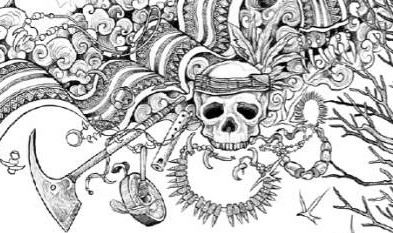
It adds up to a novel about historical narrative that is both thrilling and complex, both empowering and heavy with grief. From the forest, the rattling bone-offerings in the Bone Tree (portrayed so ravishingly in Kerby Rosanes’ cover art) speak of the Americans bringing new time to the Bontoc ancients: A day is made of hours. A month is made of days. A year is made of months. And a man is made of years.Samkad and Luki, who have lived through this revolution in time, have perhaps ended up with a more nuanced understanding of what it means to grow. I’d love to hear the story of what happens next, for Samkad, Luki and their families, but that is also the strange subjective power of a historical narrative such as this, which leads us to the very edge of fiction. There is always more to learn.

The Carnegie Medal has some history with history. Over the years, historical drama has been its most rewarded genre (while many other awarded novels have been seriously engaged in exploring the past). Winners in 2015, 2017 and 2018 were all historical fiction. (Is this about children’s fiction, the prize’s judges or revisionist historical fiction beyond those worlds?) Moreover, it’s been a while since the Medal went to a middle-grade book: again, is that the nature of children’s fiction, the character of the prize, an overdue acknowledgement of Young Adult reading, or what?

Whatever the outcome, Bone Talk deserves a place on your bookshelf: its momentum will carry even reluctant readers deep into territory they did not expect…